Digital Disruption- Why isn’t Leeanne Enoch’s son getting his drivers licence?

I had the privilege to hear the Hon, Leeanne Enoch, then Queensland Minister for Small Business, Science and Innovation speak at a Logan Chamber of Commerce business breakfast. For many in the audience, the story she told was a wake up call to the changing world we will be living in.

Leeanne spoke about how her first son, now 20, was so eager to get his drivers licence at age 16. He was completing his logbook and pestering his mum for driving lessons to complete his logbook hours. As soon as he turned 17 he was going for his ‘P’ drivers licence. For many readers this is the same situation many of us went through.

But for her second son, now 16, the experience is completely different. His mum wants him to get his licence so he is independent to drive himself places. He has no interest in getting his licence, to his mums obvious disapproval. But why isn’t he bothered with getting his licence? Well his debate is one his mother, an exceptional politician, couldn’t question! To paraphrase the Minister and her son-

“Mum, why is having a drivers licence so important? I/m 16 and I take the bus. But in a only a few years if I want to go somewhere I will take a car, but it won’t be the same way we currently use them. I won’t own a car. This will save me money by not having to buy one, maintain it and pay insurance on something I only use a few hours a week. Instead, I will pay for the hire of a car. I will use my smart phone, or another mobile device, to order a car to come pick me up. This will be similar to the current car sharing economy apps we already use.

I won’t be needing my licence. In fact, needing to know how to drive a car will be unnecessary. The car that comes to pick me up will be selfdriving. It will be one of the many different types of self driving cars that are being tested right now! The car will pick me up, drop me off to where I have ordered it to drop me off. The car will then drive off to pick up its next passenger.”

To further her son’s argument-

The car will be in use 24/7. This means we will see the age of vehicles on the road reduce to be no older then 5 years as they will quickly rack up the kilometres.

It will also mean reduced need for parking space and storage of cars in home garages or on streets. In fact, the cost of the fair will be reduced by selecting to share a car with others also going in your direction. This will reduce the number of cars on the road. We will also have less environmental emissions as a result. Not just because we are using electric cars, but because they will be powered by more environmentally friendly sources of energy as solar.

That is an argument that is being had today. What arguments will be had in 5 years time with teenagers?


Which Accountant Do I Use?

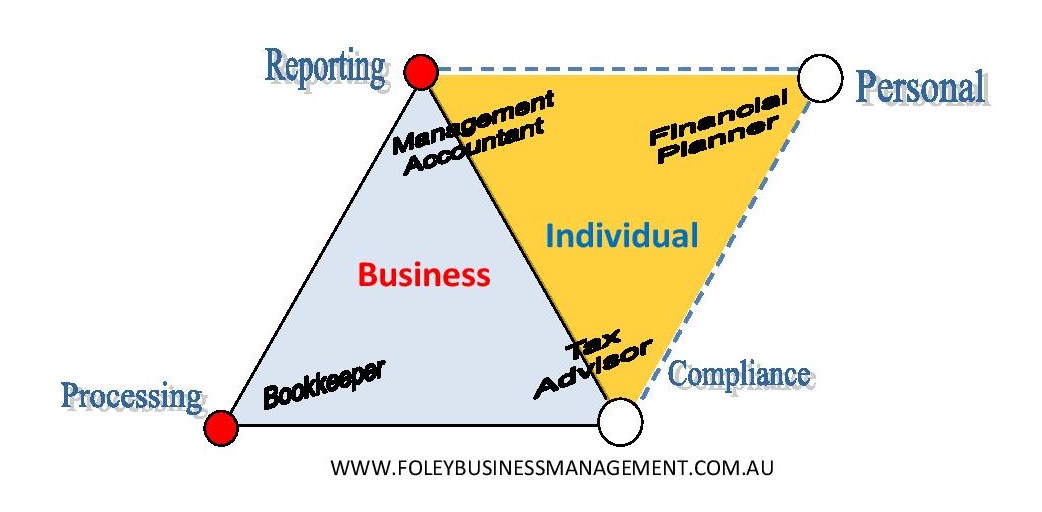
Slanted square with different types of accountantsAccountants are like doctors. If you have a problem with your foot, you speak to a podiatrist. Why? Because you want to speak to the professional with the the most knowledge and experience in that area. Lets run through some of the people who you will speak to around your finances.

4 Different Financial Accountants and Advisors

Bookkeeper

This is the person who does the processing of your accounts to make sure the transactions are entered correctly. In Australia, many Bookkeepers are BAS Agents. You can speak to your Bookkeeper about the day to day aspects of your accounts. For example, your bank account balance, your accounts payable balance and accounts receivables balance. As a BAS Agent they can prepare and discuss your GST liability. Bookkeepers can give general information around your accounts. They are limited in what advice they can provide you.

Management Accountant

Your Management Accountant, can also be your management consultant or company accountant. They are able to give you insight into your business by doing an analysis of your business each month or quarter and providing you with reports and explanations on how you are performing. They are in the position to give you advice on your business to assist you to make more informed business decisions.

Tax Advisor

Your Tax Advisor ensures you are meeting your compliance obligations by providing you with technical advice and services. They can prepare your GST or provide you and your bookkeeper the technical advice on the most appropriate treatment given. They prepare your accounts and tax returns at year end for you and your business, making sure they are compliant for the tax office and other regulatory authorities.

Financial Planner

Your Financial Planner advises you on your current and future personal financial position. Your business is an asset and source of income so it forms a part of this discussion. They manage and advise on affairs such as your superannuation, insurances and investments such as shares.

Relationships

Each has their own area of specialty, but they also work together.

Bookkeeper and Management Accountant

The Management Accountant relies on the Bookkeeper to process and allocate transactions correctly to ensure reports are accurate. Your Management Accountant can work with your Bookkeeper around the reports required and how to setup the accounts to produce the best reports.

Bookkeeper and Tax Advisor

The Bookkeeper will work with the Tax Advisor for technical advice on matters as the correct treatment of transactions for GST and other tax matters. The tax Advisor will require the bookkeeper to prepare the accounts to a standard that allows the Tax Advisor to prepare the financial statements and tax returns. The relationship is sometimes described like a race car driver and the mechanical engineer.

Management Accountant and Tax Advisor

The Management Accountant prepares reports each month and reports this to the client and to the Tax Advisor. This allows the Tax Advisor to plan for the clients tax position before the end of the financial year. The Tax Advisor can then advise what to do prior to the end of the financial year to optimise the clients tax position. For example, the Management Accountant reports may indicate the client will have a larger then anticipated profit at year end, being in three months time. The Tax Advisor can then advise the client on ways to reduce their tax bill in preparation for year end. The Management Accountant can assist the client in implementing this advice.

Management Accountant and Financial Planner

Like the Tax Advisor, the Management Accountant can provide the Financial Planner with business management reports. The Financial Planner can advise the client on what to do with any additional cash in the business from profits or what insurances the client should consider for  the business and themselves.

Financial Planner and Tax Advisor

The Financial Planner and Tax Advisor can both work together on the clients financial position and look at their tax obligations. For example, the business is generating a profit, the Tax Advisor may suggest the client look at some tax effective investments. The Financial Planner may advise on investing more into superannuation through salary sacrifice.

So Which One Do You Use?

If you have a business, all four different advisors are important to you and your business. So when thinking about who you should talk to, you first need to ask who is it for?

If it is for your business, then you will need someone to do your compliance, your Tax Advisor; someone to process your financial information correctly, your Bookkeeper; and someone to analyse and discuss your business financial performance regularly, your Management Accountant.

If it is for you as the individual you will need to talk to someone who can discuss your personal wealth goals, your Financial Planner; someone to prepare your tax returns, your Tax Advisor; and someone to action this within your business, your Management Accountant.

Each of the four contributes to the improvement of you and your business’ financial wealth. Working together, they can provide greater insights into your business and personal finances to allow you to make the necessary improvements.

If you are seeking a bookkeeper or management accountant, consider Foley Business Management. We provide financial management solutions that will allow you to make more informed business decisions around your finances. We want to ensure your business succeeds, providing benefits to you, your family and your community. Our staff have experience working with tax advisors and financial planners. For a 30 minute free initial consultation just email enquiries@foleybizmngt.com


What do I need to ask my accountant before starting a business? 10 questions you need to ask your accountant!

starting a business

Your accountant is a key source of advice on how to start a business. They come with knowledge and experience you can take advantage of if you know the right questions to ask.

If you type in the word ‘businessman’ or ‘businesswoman’ into Google, the images you will see will be all high powered corporate’s in navy blue suit’s. But the reality is many start up businesses are not from a business background. So it is not reasonable to expect you to know everything there is about setting up and running a business.

When I have a leaking pipe, I call a plumber to fix it and I am happy to pay them for it. If the plumber wants business advice, then they come to me and are happy to pay for it.

So to help you on your way to starting your business, here are 10 questions you should ask your accountant before you start.

1. Am I a business?


Some people will start a business that, well, really shouldn’t be a business. There are circumstances where you won’t need to be set up as a business as you simply don’t make enough money or your business really is a hobby.

In certain circumstances it is to your detriment to be a business.  So ask your accountant if you need to be a business. This might save you dollars and hard work you don’t need to do.

2. How should I set up my business?

This is your first question (okay, first question after the first question!) as this establishes how your business will be set up. For example, should you set up as a sole trader, a partnership, a company or a trust? Each will have their pros and cons. Have your accountant ask questions from you about you and your proposed business so they can give you the best advice possible.

3. What are the costs and benefits of this business set up?

Most people consider the initial costs when discussing this point. That is to say how much will it cost to buy a company or draw up a trust deed. But the costs go beyond the initial establishment costs. Consider the ongoing maintenance costs such as accounting fees, annual lodgement fees etc. Also discuss what protection the business structure offers if anything goes wrong. Will the structure protect not only the business assets but more importantly your personal assets such as your house and investment’s?!

4. What type of business do I have? What is Personal Services Income (PSI)?

Leading from question 1, many people take an Australian Business Number (ABN) to make a few extra dollars in addition to their employee pay, especially labourer’s and tradies. But there are rules around how your income is treated and what you can claim for tax deductions. So ask your accountant if you’re business is a PSI business and what that means.

5. Do you have experience in doing work for this type of business?

To give a better understanding about accountants, not all accountants prepare tax returns for a living. Some specialise in certain fields of accounting or in certain industries. For example, doctors can be general practitioners or specialists, accountants can be similar. Asking if your accountant has experience in your business industry is helpful to know but not always necessary.


Ask them what services they can provide you also. For example Foley Business Management provides bookkeeping services including the preparation and lodgement of Business Activity Statements (BAS). We also have additional services, providing management accounting and reporting  and consulting.

6. Will I need to register for GST?

This is an important question as it will

  • impact your selling price
  • your ongoing costs for the preparation and reporting of your Business Activity Statements (BAS) to the Australian Taxation Office
  • paying GST owed.

7. What insurances will I need?

For many businesses you will need some form of insurance. Some of the most common types of insurances a business may have are

  • professional indemnity;
  • product and public liability;
  • income protection or key man insurance,

It is important you have the necessary insurances in place before you start actually trading. Insurance is something you realise you really need after something goes wrong. At this time it is already too late!

8. What expenses should I consider for my business?

A lot of people don’t realise there are a number of business expenses that goes into a business. In addition to the establishment costs there are insurances, accounting, bookkeeping, rent, motor vehicle, mobile phone, plant and equipment, utilities as electricity and water etc. These can be upfront and or an ongoing cost of doing business.

9. What personal expenses can I claim in my business?

Sometimes a draw card to owning a business is being able to claim personal expenses such as a motor vehicle or gym fees and equipment as a ‘business expense’. But the reality is you can’t claim personal expenses. In many cases you will need to justify them as a legitimate business or work expense to claim all or part of the expense as a deduction. BEWARE!! The ATO has identified it will be targeting and scrutinising small businesses in 2017/18.


Some purchases you cannot claim the whole costs irrespective of the business use, such as on a luxury motor vehicle. There is the possible issue that having your business pay for personal expenses will incur Fringe Benefits Tax. Ask your accountant what Fringe Benefits Tax is.

10. Does the business sound like it has potential?

This is where a good accountant with general or specific experience with businesses will be able to give you some feedback. They may not tell you whether the business is going to be a success or failure, but they can give you some critical feedback of their considerations. At the end of the day, you will be the one that makes the decision, not your accountant. But a good accountant will give you their opinion on the matter within means or at least some points to consider before you proceed.

11. BONUS QUESTION- Am I better off just staying as an employee?

Who wants to become the next Mark Zuckerburg or Bill Gates?! Being a business owner sounds great. You become your own boss, you don’t answer to anyone but yourself, you don’t have to worry about superiors telling you how to do your job. Best of all the money you make from your work goes to you. You’re the King of your domain!


The reality is different. 80% of businesses fail in the first year. Nobody sets out to start a business with the intent to fail, but for every 10 that start, 8 will fail. Consider your options.


For some people being an employee and earning a wage is better than pouring all of your savings into a money pit only to go broke.  It is also easier being an employee where your work day starts at 9am and finishes at 5pm, from Monday to Friday. When you’re in business you are working 24/7 as you will never switch off from thinking about it.

Still Feel Like You Need More Help?

Starting a business can be daunting for anyone. As we discussed, a plumber is great at fixing pipes, a management accountant is great at business advice. You aren’t meant to know everything there is before you start and you want to get on with doing what you do best.

Foley Business Management provides financial management solutions to assist small business, not for profit and social enterprise make more informed business decisions around their finances. We provide bookkeeping, management accounting and reporting and consulting services.

If you would like to speak to us as part of our free 30 minute initial consultation then email enquiries@foleybizmngt.com and we will contact you to organise a time to speak over the phone. This is a no obligation service we provide to those wanting to start their journey into business. Otherwise email us your question and we will try to reply with a general response to your situation. This is a once off email provided free, as we have a commitment to our clients to service them.