The valuable role a mentor plays in your life and business

Mentors are a vital source of knowledge and experience both in life and business. So why don’t more people have mentors? Where do you find mentors? Who should be your mentor?

Two things happened this week which brings me to write this article. First I was both a workshop presenter and panel member at the Walan Mayinygu Indigenous Entrepreneurs Pop Up Hub in Port Macquarie, NSW, Australia. The role of mentors was a topic that resonated with those in the audience. Secondly, I have just begun as a mentor for a student at a local university here in Brisbane. This is the second year I have taken on the role as a student mentor. Mentoring is a part of Foley Business Management’s core value of ‘Legacy: To create a better world for our children’s children’.


What is a mentor?

First we need to understand what a mentor is. Mentors are often mistaken as sources of advice. While this is true to an extent, it is not the role of a mentor to come up with the answers. You first need to understand the difference between a mentor, a coach and a consultant. We are just going to focus on mentors for this article.

Mentors can be a source of

  • Knowledge- They come with learning from their education be it learnt from books or life.
  • Experience- They have already done what you are wanting to do. They bring an understanding of success and failure, right and wrong, the highs and the lows.
  • Networks- They have connections with other people in and around their profession or business.
  • Guidance- They can provide guidance on what to consider for your next steps towards realising your goals.
  • Professional Development- They can give you awareness of what to consider to develop yourself personally in your career or your business.

Many mentors

You may have different mentors in your life for different reasons. In life you generally will have people you go and speak to about certain matters you are experiencing. For each different situation you may speak to different people based upon the situation. Likewise in our career or in business you should have certain people you go to speak with about certain matters as to others. So you should seek to have a number of mentors in different areas!

Experienced

For many a mentor is someone you may already know or you may seek out. You will have some level of confidence in them that you are receiving the right feedback from someone who has already been in your position or is aware of what is required.  Note I use the word ‘feedback’ and not advice. This is very important as Mentors are not consultants!

Sounding Boards

Mentors are firstly a sounding board. They’re someone you run something by to gain their feedback on the matter. For example,

A student may ask questions about what it’s like working in accounting? What type of work such as tax and audit? Should they apply to work in a Big 4 accounting firm, mid tier or small tier practice? Or should they work in commercial or as a company accountant? I can give my feedback on this based on my experience working in public practice and in commercial and what to expect working in the different tiers based on my discussions with other accountants.

From the business owner I may be asked about what are the pro’s and con’s of starting a business? Who should they talk to about a particular business matter? What have I learnt from starting a business? Should they start working in their business full time?

Finding the answer

Most of the time as a mentor I do not give a response to the question but ask a question that is relevant to the person based upon the question.

For example, if a mentee asked ‘should I go into business full time?’ My response might be ‘do you have the clients to go into full time business with?’ This is a question but with a specific focus around the person’s ability to earn money. The response question makes the mentee open and broaden their mind as part of learning in the mentee/mentor relationship.

A student may ask ‘should I go into public practice or commercial accounting?’. My response back might be. “They are different and have their pro’s and cons. Do you have a preference?” Again, the purpose of the response is to find out if the student has their own preferred choice of career path. This may also be followed with “Do you know what type of work you would do in public practice and in commercial accounting?” as in most cases the student will not.

Where do I find a mentor?

You may already know people who can be your mentor. For example, if you are thinking of starting a business, you may already know someone in business to ask questions from. If you don’t, you may want to go along to a Chamber of Commerce night with other business people.

If you’re wanting to speak to someone who has experience in your particular business area, then you might want to speak to people you know through your associations. For example, an electrician wanting to find out about starting a business in air conditioning installation may want to talk to a building industry association.

If you want to find someone very specific or niche, such as an Indigenous business owner, you can reach out to people online. This could be from emailing them directly from a search using Google or using Facebook or LinkedIn to connect. Please note I don’t accept unknown connections through LinkedIn unless we have already met and I know you. Or you have at least sent a message with your LinkedIn request explaining who you are and why you want to connect.

Who should be your mentor?

Sometimes people will reach out to people who are not necessarily going to be able to provide the time and knowledge that is needed. So if you’re starting out in business, don’t necessarily reach out to Richard Branson or Warren Buffett to become your mentor. Aim for people who are where you want to be in 5 to 10 years…. and be realistic!!!!! Ask someone who has ran their business for 5 years what their experience has been and what lessons they have learnt. Learn from both their success and failure.

Free or Pay?

Remember that some people you meet are professional coaches or consultants. So the line between mentor and these may overlap when it comes to feedback or advice. So if someone you approach is a professional, you want to clarify with them whether they charge for the service. You then have the choice of either accepting their fee or kindly declining. Don’t be offended if they ask for you to pay them. This is how they make a living to provide for their family- putting food on the table, a roof over their heads and paying their bills. Volunteer work and goodwill aren’t accepted by Woolworths or AGL as forms of payment for groceries and electricity bills.

The price you pay for ‘free advice’

Subscribe to our podcast channel to hear all of our latest podcasts at

https://foleybusinessmanagement.podbean.com/feed/

The ‘F’ word

‘Free’ is my second favourite four letter “F” word after ‘food’. Who doesn’t love free stuff, especially ‘free food’?! But sometimes free comes at a price! The following is a true story but with some change of details to conceal the identity of the people involved.

The price you pay for free advice

The story…..

Brian the engineering student

A few year’s into my career as an accountant I was talking to Brian, a friend who just started university. Brian was studying engineering so was quite bright and intelligent. We were talking about our work and how it was going to help us achieve our goals in later life. We were both going to save our money in our careers and build up a portfolio of investment’s to enjoy with our family.

‘I can’t wait to finish university and start making some real money’ Brian said.

‘It is great to start working full time earning a professional salary. I have more money then I had as a student and I have started saving and investing. I have even set up a trust for investing in.’ I said.

With a pause in conversation Brian’s face changed to one of curiousity. His mind digested the words I had just spoken.

Brian was now clear with his question and asked ‘What is a trust and why are you using it?’

In good trust

I began to explain my new learnt understanding of tax and legal structures I had gained from working as a tax accountant.

‘Well, a trust is a way to hold assets for the benefit of the trust beneficiaries. My trust beneficiaries are my family members. So I buy investment’s in the trust. When I make a tax gain or profit in the trust, that is distributed to the beneficiaries, which are my family. We use a discretionary trust so we can allocate the distribution based on what is the most tax advantageous way. So it is also a way to reduce the tax we pay on the profit.’

I continued to explain more as Brian asked more questions. It included how I used a lawyer to create the trust, the benefits a trust had over a company, how the trust could be used to also protect assets.

‘Wow, that’s really great to know. Thanks!’ I could see the excitement on Brian’s face as he thought about how a trust could be used for him and his family.

10 years later….

Henry the business student

Some 10 years later I was at a university student and alumni networking event. I was talking to Henry, a mature age student who grew up in my home town. As it turned out Henry was Brian’s cousin. I told Henry I was an accountant.

Henry replied ‘I wish I knew you 5 years ago.’ He said shaking his head.

‘Why is that?’ I asked.

Henry explained. ‘I won $20,000 in a lottery. It was the first large sum of money I ever had. I didn’t want to blow it and my family also encouraged me to do something good with it. My family told me I needed to use it for my future, so I had a lawyer create a trust. The lawyer charged $8,000 in fees to create the trust. Then there was accounting costs. Within 3 years there was less than $10,000 in the trust so we decided to pull it out as it was costing too much.’

Bad advice

I was disheartened by Henry’s story. I put two and two together and could only assume Brian had convinced Henry that he needed to set up a trust based upon our conversation.  I was the one who told Brian about trusts. I was upset with both myself and Brian. Brian was a smart guy. But he didn’t have the knowledge and years of experience to know when and how to use a legal structure such as a trust. He wasn’t the right person to be giving tax and financial advice. I could only sit there and think ‘if only Henry had spoken to someone who would have given him the right tax and financial advice. Then he would be better off instead of worse off as an outcome. What was $20,000 was now less than $10,000.’

The moral of the story

The moral of the story is that while getting something for free is great, it could possibly cost you more in the long run.

So learn from Henry’s story. Speak to people with the right knowledge and experience to get the right advice for you. But be prepared to pay for it. While it will cost you money now, it will save you a lot more in the future.

The silver lining

The silver lining to this story is that in losing this money, Henry realised how much he didn’t know about money. So he decided to go to university and do a degree in business. Henry was using what was left of his $20,000 to help pay his way through university over the coming years. Henry is a smart guy, but Brian’s free advice as someone who didn’t have the right knowledge and experience had cost Henry a lot of money.


Digital Disruption- Why isn’t Leeanne Enoch’s son getting his drivers licence?

I had the privilege to hear the Hon, Leeanne Enoch, then Queensland Minister for Small Business, Science and Innovation speak at a Logan Chamber of Commerce business breakfast. For many in the audience, the story she told was a wake up call to the changing world we will be living in.

Leeanne spoke about how her first son, now 20, was so eager to get his drivers licence at age 16. He was completing his logbook and pestering his mum for driving lessons to complete his logbook hours. As soon as he turned 17 he was going for his ‘P’ drivers licence. For many readers this is the same situation many of us went through.

But for her second son, now 16, the experience is completely different. His mum wants him to get his licence so he is independent to drive himself places. He has no interest in getting his licence, to his mums obvious disapproval. But why isn’t he bothered with getting his licence? Well his debate is one his mother, an exceptional politician, couldn’t question! To paraphrase the Minister and her son-

“Mum, why is having a drivers licence so important? I/m 16 and I take the bus. But in a only a few years if I want to go somewhere I will take a car, but it won’t be the same way we currently use them. I won’t own a car. This will save me money by not having to buy one, maintain it and pay insurance on something I only use a few hours a week. Instead, I will pay for the hire of a car. I will use my smart phone, or another mobile device, to order a car to come pick me up. This will be similar to the current car sharing economy apps we already use.

I won’t be needing my licence. In fact, needing to know how to drive a car will be unnecessary. The car that comes to pick me up will be selfdriving. It will be one of the many different types of self driving cars that are being tested right now! The car will pick me up, drop me off to where I have ordered it to drop me off. The car will then drive off to pick up its next passenger.”

To further her son’s argument-

The car will be in use 24/7. This means we will see the age of vehicles on the road reduce to be no older then 5 years as they will quickly rack up the kilometres.

It will also mean reduced need for parking space and storage of cars in home garages or on streets. In fact, the cost of the fair will be reduced by selecting to share a car with others also going in your direction. This will reduce the number of cars on the road. We will also have less environmental emissions as a result. Not just because we are using electric cars, but because they will be powered by more environmentally friendly sources of energy as solar.

That is an argument that is being had today. What arguments will be had in 5 years time with teenagers?


Which Accountant Do I Use?

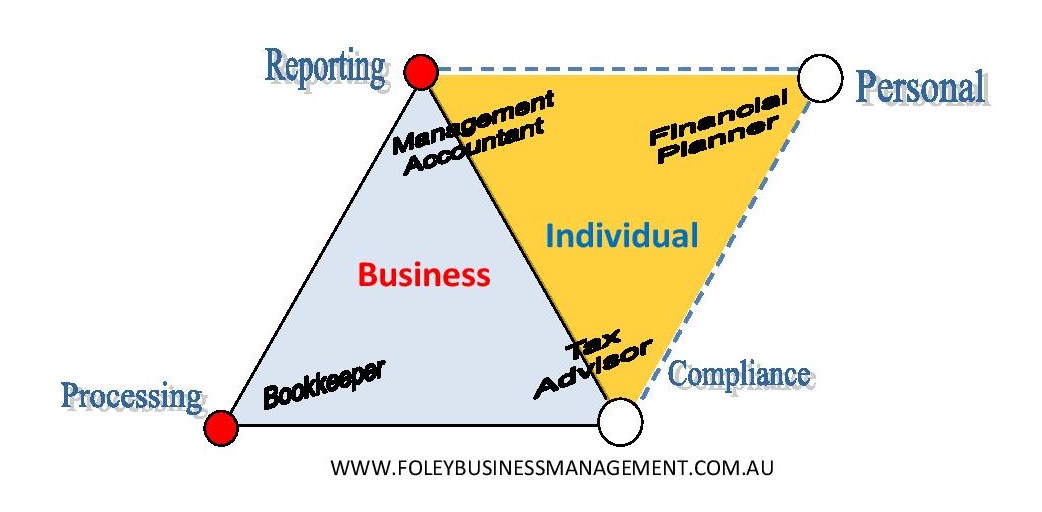
Slanted square with different types of accountantsAccountants are like doctors. If you have a problem with your foot, you speak to a podiatrist. Why? Because you want to speak to the professional with the the most knowledge and experience in that area. Lets run through some of the people who you will speak to around your finances.

4 Different Financial Accountants and Advisors

Bookkeeper

This is the person who does the processing of your accounts to make sure the transactions are entered correctly. In Australia, many Bookkeepers are BAS Agents. You can speak to your Bookkeeper about the day to day aspects of your accounts. For example, your bank account balance, your accounts payable balance and accounts receivables balance. As a BAS Agent they can prepare and discuss your GST liability. Bookkeepers can give general information around your accounts. They are limited in what advice they can provide you.

Management Accountant

Your Management Accountant, can also be your management consultant or company accountant. They are able to give you insight into your business by doing an analysis of your business each month or quarter and providing you with reports and explanations on how you are performing. They are in the position to give you advice on your business to assist you to make more informed business decisions.

Tax Advisor

Your Tax Advisor ensures you are meeting your compliance obligations by providing you with technical advice and services. They can prepare your GST or provide you and your bookkeeper the technical advice on the most appropriate treatment given. They prepare your accounts and tax returns at year end for you and your business, making sure they are compliant for the tax office and other regulatory authorities.

Financial Planner

Your Financial Planner advises you on your current and future personal financial position. Your business is an asset and source of income so it forms a part of this discussion. They manage and advise on affairs such as your superannuation, insurances and investments such as shares.

Relationships

Each has their own area of specialty, but they also work together.

Bookkeeper and Management Accountant

The Management Accountant relies on the Bookkeeper to process and allocate transactions correctly to ensure reports are accurate. Your Management Accountant can work with your Bookkeeper around the reports required and how to setup the accounts to produce the best reports.

Bookkeeper and Tax Advisor

The Bookkeeper will work with the Tax Advisor for technical advice on matters as the correct treatment of transactions for GST and other tax matters. The tax Advisor will require the bookkeeper to prepare the accounts to a standard that allows the Tax Advisor to prepare the financial statements and tax returns. The relationship is sometimes described like a race car driver and the mechanical engineer.

Management Accountant and Tax Advisor

The Management Accountant prepares reports each month and reports this to the client and to the Tax Advisor. This allows the Tax Advisor to plan for the clients tax position before the end of the financial year. The Tax Advisor can then advise what to do prior to the end of the financial year to optimise the clients tax position. For example, the Management Accountant reports may indicate the client will have a larger then anticipated profit at year end, being in three months time. The Tax Advisor can then advise the client on ways to reduce their tax bill in preparation for year end. The Management Accountant can assist the client in implementing this advice.

Management Accountant and Financial Planner

Like the Tax Advisor, the Management Accountant can provide the Financial Planner with business management reports. The Financial Planner can advise the client on what to do with any additional cash in the business from profits or what insurances the client should consider for  the business and themselves.

Financial Planner and Tax Advisor

The Financial Planner and Tax Advisor can both work together on the clients financial position and look at their tax obligations. For example, the business is generating a profit, the Tax Advisor may suggest the client look at some tax effective investments. The Financial Planner may advise on investing more into superannuation through salary sacrifice.

So Which One Do You Use?

If you have a business, all four different advisors are important to you and your business. So when thinking about who you should talk to, you first need to ask who is it for?

If it is for your business, then you will need someone to do your compliance, your Tax Advisor; someone to process your financial information correctly, your Bookkeeper; and someone to analyse and discuss your business financial performance regularly, your Management Accountant.

If it is for you as the individual you will need to talk to someone who can discuss your personal wealth goals, your Financial Planner; someone to prepare your tax returns, your Tax Advisor; and someone to action this within your business, your Management Accountant.

Each of the four contributes to the improvement of you and your business’ financial wealth. Working together, they can provide greater insights into your business and personal finances to allow you to make the necessary improvements.

If you are seeking a bookkeeper or management accountant, consider Foley Business Management. We provide financial management solutions that will allow you to make more informed business decisions around your finances. We want to ensure your business succeeds, providing benefits to you, your family and your community. Our staff have experience working with tax advisors and financial planners. For a 30 minute free initial consultation just email enquiries@foleybizmngt.com


St Patrick’s Day 2017- Irish Business People in Australia

Foley Business Management has turned our logo from blue to green this week to recognise St Patrick’s Day.

In the lead up to St Patrick’s Day, we recognise the Irish business people of Australia. The Irish have  long connection to Australia since the First Fleet. Ireland has undergone numerous economic and political change that has influenced how business is done both at home and abroad. We have interviewed two Brisbane based Irish business people to share their experiences of Ireland and doing business in Australia.


David GreeneDavid Greene, President of the Queensland Chapter and National Board Member, Irish Australian Chamber of Commerce.


Catherine GabottCatherine Gabott, Owner and Director of Suppawtive Solutions.


St Patrick’s Day- Catherine Gabbott, Owner and Director of Suppawtive Health Solutions

In the lead up to St Patrick’s Day, we are recognising the contributions of Irish business people who now call Australia home. In this article we interview Catherine Gabbott, owner of Suppawtive Health Solutions.

What is your fondest memory of Ireland?

The winter snow was always one of my favourite times. Both as a child and as a teenager in college we would engage in snowball fights and have a lot of good fun and laughs doing so. As an adult, I really appreciated the history of Ireland. The vikings invaded Dublin in 988 and evidence of their habitats exists to this day. Ireland has a long rich history which is evidenced in its architecture and artefacts, like the Book of Kells which is housed in Trinity College. For me, the images of Dublin City evoke fond memories of growing up there rather than images of green rolling hills. This is because I am a city girl and always will be, Dublin will always be where my heart belongs.

What made you the business person you are today?

I originally started out in IT but have always had a love to work with animals. A few years ago I got the opportunity to work as a dog trainer with the RSPCA in Queensland. It was this opportunity that enabled me to realise a new passion in my life. It led me to study a Diploma in Animal Naturopathy and starting my own company.

I can’t pinpoint one thing that made me the business person I am today, but a lot of life’s hurdles helped me grow as a person as well as some great opportunities that opened the proverbial doors. I have always followed what I felt was right at the time and believed that I have the capability to do whatever I set my mind too. I believe that it is more this drive and belief in myself while doing something that I love that has made me into the business person I am today.

What does your typical work day involve?

A typical day for me involves checking emails, making appointments and visiting clients in their home to discuss their animals health and nutrition. Following a consult I prepare a treatment plan that is customised to the clients pet. A follow up consult occurs 2-4 weeks after the initial consult to review the animal and monitor its progress.

I will very soon be a qualified Canine Bowen Therapist. This means I can use massage to help dogs recover from physical injuries or where they are stiff and sore due to soft tissue problems and degenerative conditions.

Why do you do what you do?

I started on this path due to the death of a beloved pet, my dog Pepper. All his life Pepper had been plagued with health issues from hot spots, ear infections, itchy paws to tummy upsets. After his death from pancreatitis I started researching animal nutrition and basically had a light bulb moment. I realised that what I had been feeding him was the cause of all his problems. I then enrolled to study Animal Nutrition and loved what I was learning so much I quickly realised that this was a career that I wanted to follow.

When you speak to people in the animal care industry, many will have an animal in their life that somehow influenced their decision to get into this field. Whether it was adopting a rescue animal, taking a dog to a training class and then become a dog trainer, to having a sick animal. Although Pepper’s death was a terrible tragedy it was his death that put me onto this path and the belief that I can help prevent another animal suffering the way he did.

What is instilled in you from your Irish upbringing that has made you the person you are today?

The Irish people have a passion and drive that is different to other cultures. I have lived around the world and there is something different about the Irish. I think growing up in the era that I did, where there was a big change happening in Ireland, helped me stand up for what I believe in and follow what I believe is the truth. In the field that I am in there is a lot of skepticism and controversy so you have to be strong to stand by your beliefs for the betterment of a pets life.

What don’t we have in Australia that is in Ireland you would like to bring here?

Australian doesn’t have the architecture that I miss from Ireland, the really old buildings dating back many centuries. However, Australia has sunshine which is something seriously lacking in Ireland.


St Patrick’s Day- David Greene, President of the Queensland Chapter and National Board Member, Irish Australian Chamber of Commerce

David GreeneIn the lead up to St Patrick’s Day, we are recognising the contributions of Irish business people who now call Australia home. In this article we interview David Greene, President of the Queensland Chapter and National Board Member, Irish Australian Chamber of Commerce.

What is your fondest memory of Ireland?

I always remember the rare hot summer days.  We’d only get a couple of days every year when the temperature would stay in the 20s.  I remember thinking then, and still believe now, that it was the nicest place in the whole world when the sun shone. Strolling deserted country lanes, picking blackberries, listening to the birds – an idyllic childhood.

What made you the business person you are today?

The greatest gift we have as Irish people and Irish-Australian’s is our connection to one another – a shared understanding, and often, a shared set of beliefs and frameworks in which we conduct ourselves in both our professional and personal lives.  It was in search of those connections that I first became involved with the IACC, and my role as the Queensland Chapter President is, in most respects, in service to that greater goal of helping Irish people, or those with an affinity for Ireland, to connect, and grow and prosper.

What does your typical work day involve?

A whirlwind of activity from early morning to late evening.  Balancing my professional role as a solicitor, with my role as Queensland Chapter President of the IACC.  I typically get to work around 7.30, and catch up on emails and updates on case law.  Mid-morning is usually a good time for phone calls, and then onto meetings until lunch.

Afternoons typically involve the “heavy lifting” of drafting submissions, preparing for Court, and everything else that goes into a busy solicitor’s day.  I usually leave the office anytime between 5 and 6, and use the commute to make more phone calls.  After dinner, I often get time to reply to more emails and plan out the following day.

There is no distinct separation between my IACC tasks and my solicitor tasks – activities for both are interspersed throughout the day.

Why do you do what you do?

I became a solicitor because I wanted to do good work for ordinary people.  Its that mission, more than anything else, which keeps me going.  I became involved with the IACC, and became Queensland Chapter President, because I felt there was something I could add, and wanted to help other young Irish professionals to make the vital connections necessary to survive and thrive in Australia.

What is instilled in you from your Irish upbringing that has made you the person you are today?

That’s easy – a real and lived form of social justice.  Where I grew up, there was a very strong community and a shared sense of success and failure.  The community, in many respects, shared grief in tragedy, prosperity in the good times, and poverty in the bad times.   There was also a strong sense of “live and let live”, and each of those elements have combined to produce a truly remarkable shared ethos and understanding.

What don’t we have in Australia that is in Ireland you would like to bring here?

Personally, and like most people, I miss my family and would love to have them join me here.  However, I truly believe that if we could bring even a shred of the community spirit which exists in Ireland to the suburbs we live in here in Australia, then this nation would be changed utterly for the better.


From The Oscars to Graduate Recruitment Videos

https://www.youtube.com/watch?v=0zlEFTgk1tg

Within days of each other accountants have been in the ‘spotlight’ for getting laughs….. but not for the right reasons. First, the mix-up with an Oscars envelope for ‘Best Picture’ now termed envelopegate. Second, an ‘excruciating’ recruitment video from the Australian Department of Finance to attract graduates. So how are accountants viewed?

Trust is key

While we do have our moments, generally accountants are viewed as one of the most trusted professions. In fact we have been consistently ranked 11th in the Roy Morgan’s Annual Image of Professions Survey. Deloittes was ranked number one to work by graduates by GradConnections. But the accounting profession has been undergoing significant change.

Meeting client growing needs

Accounting firms are now calling themselves ‘consulting’ firms and their accountants now referred to as consultants. Why? Because the profession is now becoming a more broad service provider to business. No longer are we just ‘number crunchers’ and ‘bean counters’ preparing tax returns and financial statements. Our services have gone further into providing advice and information to business managers. This allows business managers to make more informed decisions. Technology now extends into providing information technology services in accounting. For larger firms they are becoming ‘one stop shop’ business service providers to business. This has seen them competing with consulting firms as McKinsey & Co, Bain & Co, Boston Consulting Group.

Remaining relevant with customers

Bookkeepers and management accountants are no different. With the introduction of Goods and Services Tax in Australia, the role of bookkeepers has become important. Our role with owners and management has become more intimate. Business is becoming more technology based through transactions, e-commerce, online banking, cloud accounting and many addon features. Our knowledge, skill and experience is critical to success. It’s becoming necessary for business to keep up with competitors. Remaining relevant with customer technology needs is required by business.

Technology key to innovation

To demonstrate how technology influences business, let’s look at some of the best performing USA stocks in the last 20 years. We see Facebook, Amazon, Microsoft, Google and Apple. Watching Sky News “Smart Money”, Xero Managing Director Trent Innes identified the cost benefits to business using cloud based technology, allowing remote access to their business on mobile devices as smartphones and tablets. This allows business success through innovation and improved cashflow management. This is followed by CEO Simon Griffith from Who Gives a Crap, an online social enterprise. Their purpose is to build toilets for those in need by selling 100% recycled paper cleaning products online. They use tehnology to streamline their logistics and warehousing to minimise costs.

We’re human, but we’re needed

So yes, accountants or consultants are human. It is what makes the profession one of the most trusted and sought after. Our work is wide and varied as our clients needs change and evolve. Management accountants are sought for our intimate understanding of our clients. This allows us to provide insights they could not achieve on their own. Our role is no longer bean counting. It’s now advising and using technology to allow business owners and managers to make more informed decisions. Technology is now a growing part of the service provision for clients. Innovation is essential to for businesses to remain relevant with their customers, now and in the future.


Why Foley Business Management is relevant to your business

Our purpose is to build sustainable communities and to create a better world for our childrens’ children.

This is why we take a holistic approach to our clients, not just preparing financial statements and leaving it to the client to work out on their own. We provide financial management solutions to small businesses, not for profits and social enterprise so they can make informed decisions. For many people, owning a business is a big step. One that will affect you, your family and your community.

If you would like to speak to one of our consultants for a free 30 minute consultation, please contact us to organise a time that is convenient. A business can be a rewarding experience for you, your family and your community! Let’s make sure you do it the right way.


BEWARE accounting package addons- Don’t get burnt by the sizzle!

Addons for small business accounting packages, as MYOB, Xero and Quickbooks, are now becoming increasingly popular to use by small business owners. They offer an efficient and effective way to improve profits and reduce costs. But there are quite literally thousands of addons in the marketplace. So where do you begin? As a management accountant with experience with the addon industry, BEWARE. There is a saying in sales…..

“Sell the sizzle, not the steak”

What this means is that you do not sell the customer the product, you sell the benefits the product offers the customer. For example, you may buy a shirt not because you need a shirt, but because you like the colour and design of the shirt. The salesperson will compliment you on how it looks on you. But many people have experience in buying their own clothes. How many small businesses have experience in buying accounting addons?

Experience adds value

For the inexperienced, knowing where to find the right addon can be difficult. But what can be of greater concern is being sold something that is not right for your business, or your business doesn’t even need.

The makers of addons are out to sell their product. For the unknowing buyer, this can mean being sold a product that is not everything the seller is promising. For example, I recently contacted an addon supplier to be given a demonstration of their product as part of an evaluation for a clients problem. In being given the demonstration, I asked questions of the product as “Where does it extract it’s data from? Does it work with these features of the accounting package? Will you be making improvements in these areas?”. These questions allowed me to identify the addon was not suitable for the client.

Salespeople SELL!

These are important questions many small business owners will not consider as part of the product. Instead, the salesperson will lead them through to the buy. Is it the responsibility of the salesperson to tell the business owner to ask these questions? NO! The role of the salesperson is to SELL the product, not to put up potential reasons for the business owner not to buy. The salesperson is responsible to answer your questions or find the answer when asked. But sometimes the sales pitch doesn’t tell the whole story, or tells you what you want to hear.

Don’t get burnt by the sizzle!

If you’re not experienced, it’s very easy  to buy an addon that is not right for you because you were sold by the salesperson. DON’T GET BURNT BY THE SIZZLE! There are some ‘consultants‘ that also offer to find or sell you addons for your accounting package. What is not disclosed is the consultant may receive an incentive or commission from the sale. So you may be told that it’s the right product for you, when in actual fact it is the commission that determines what product they direct you to. I am currently seeing LinkedIn and Facebook posts for a particular type of addon being pushed by consultants. A product I know pays a very good commission based on the marketing strategy of the supplier. There is nothing wrong with this. As business owners we can relate to having a business where you want to maximise sales.

Does Foley Business Management receive incentive’s or commissions?

Yes we may. But we disclose this as part of our engagement with the client. We also make it clear we are acting in their interests as our client and not in the interests of the suppliers or our own. In fact, we have probably gone beyond this by announcing to the world in this article we may receive incentives and commissions! But we value the trust in the relationship we have with our clients by assuring them our advice is based on what is in the interests of them and their business, not what we are paid by the supplier.

Why does Foley Business Management want you to know this?

Our purpose is to build sustainable communities and to create a better world for our childrens’ children. It is easy to be sold something that is not right for you and your business. It can potentially make a good business go bad very quickly. Knowing what is best for your business is the right thing for all involved.

This is why we take a holistic approach to our clients, not just preparing financial statements and leaving it to the client to work out on their own. We provide financial management solutions to small businesses, not for profits and social enterprise so they can make informed decisions. For many people, owning a business is a big step. One that will affect you, your family and your community.

If you would like to speak to one of our consultants for a free 30 minute consultation, please contact us to organise a time that is convenient. A business can be a rewarding experience for you, your family and your community! Let’s make sure you do it the right way.


Fall in love

https://www.instagram.com/p/BQZYRJngEn5/?taken-by=foleybusinessmanagement&hl=en

That special feeling

Love is in the air with Valentines Day. It’s one of the days to celebrate the joy and happiness that comes from when two people find each other. That feeling you get when you think about them and how much they have made a difference in your world. The excitement it gives you to tell your friends and family how much they mean to you and the difference they have made in your life. That feeling you get when you see them. The little things they do for you that makes you feel extra special and them so extra special to you. You couldn’t imagine your life without them.

But you’re missing out on having these same feelings and emotions with your bookkeeper and accountant.  The beautiful relationship you could be missing out on.

having that special someone

Missing out on the feeling of both joy and relief you have when you find everything is much better and simpler by having them involved in your business. Your missing the feeling of excitement to tell others about what your bookkeeper has done for you. The feeling you get when your bookkeeper has done all your bookkeeping for you is like when you come home after a hard day of work and find your partner has cleaned the house. You know they care about you and that feeling of stress relief from not having to do it. Yes, we can sometimes take these things for granted in our relationship, but it makes your life so much easier by having them in it.

Telling your friends and family about how much they have changed you and your business with the new addon they recommended. It’s like your partner buying you a new foot massager or fragrance. It makes you feel special to know they’re thinking about you and how happy that makes you feel to know they want to make you happy.

Spending quality time with them

But your relationship is so much more than doing things for you. It’s the quality time you spend together, talking and getting to know one another. Knowing your loves and passions and what experiences you want to have with the people around you. Let’s be honest, we want to spend more time with the people we care about and give them the best in life. We don’t want to be working all the time and not being able to share quality time with the people we care about.

Make a regular date time to talk and communicate with your management accountant. Take the time to talk about what you have been doing and what you would like to do. taking time to discuss what your plans are for the next month, quarter or year. Talk about that holiday you want to take overseas, the house you want to buy, the school you want your kids to go to. Share with them both your good and bad times. Tell them about the rotten experience you have just gone through. Share with them how you haven’t had the best time lately. Sharing with them will let them know what you want, need and desire. Life is meant to live and be shared with loved ones.

Finding ‘The One’

Sometimes we have to learn from our experience in relationships. Sometimes we stay in relationships because we feel it’s ‘good enough’. You start out okay but you may feel they are not doing enough in the relationship. You feel they don’t listen, or don’t even bother to ask how you are. They are only there for one thing in your relationship. This relationship can be damaging to you and the people you care about. Sometimes we feel like in our search for ‘the one’ we settle for ‘good enough’.

You want to find someone who makes you a better version of you. Who makes you more than you are when you’re together. But do you feel satisfied in your current relationship? Are you wanting more? Do you deserve more? Do you feel your relationship is not allowing you to be more than you are? Do you feel your goals and aspirations are not aligned with one another? Do you feel there is someone out there who has more to offer you?

At Foley Business Management we want to build a relationship with you. We want to a have a trusting relationship where you feel comfortable talking with us. Tell us your dreams and aspirations for you, your business, your family, your community. We want you to enjoy our time together and look forward to our conversations. Where we take the time to listen and to understand what you are going through. We want to help you grow and become more than who you are right now.