
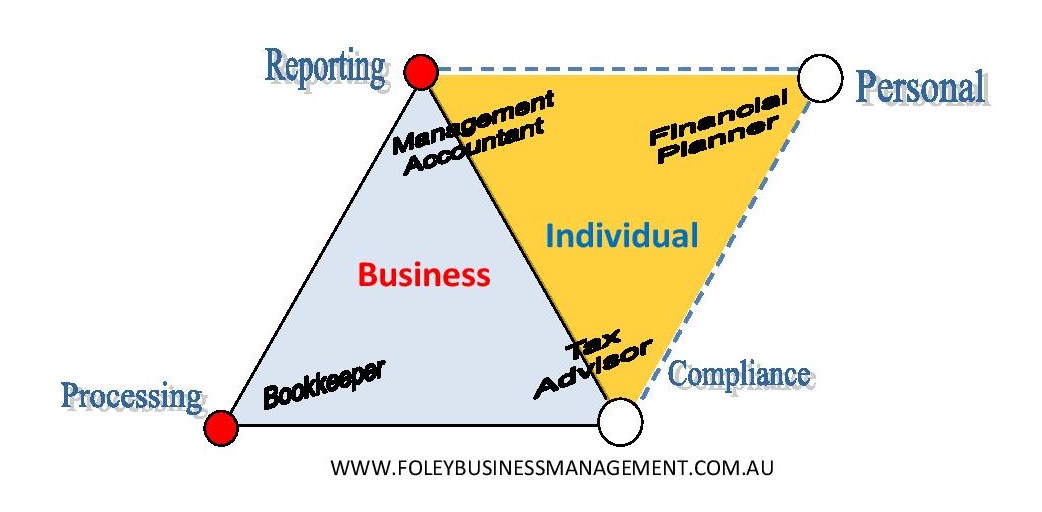
 Accountants are like doctors. If you have a problem with your foot, you speak to a podiatrist. Why? Because you want to speak to the professional with the the most knowledge and experience in that area. Lets run through some of the people who you will speak to around your finances.
4 Different Financial Accountants and Advisors
Bookkeeper
This is the person who does the processing of your accounts to make sure the transactions are entered correctly. In Australia, many Bookkeepers are BAS Agents. You can speak to your Bookkeeper about the day to day aspects of your accounts. For example, your bank account balance, your accounts payable balance and accounts receivables balance. As a BAS Agent they can prepare and discuss your GST liability. Bookkeepers can give general information around your accounts. They are limited in what advice they can provide you.
Management Accountant
Your Management Accountant, can also be your management consultant or company accountant. They are able to give you insight into your business by doing an analysis of your business each month or quarter and providing you with reports and explanations on how you are performing. They are in the position to give you advice on your business to assist you to make more informed business decisions.
Tax Advisor
Your Tax Advisor ensures you are meeting your compliance obligations by providing you with technical advice and services. They can prepare your GST or provide you and your bookkeeper the technical advice on the most appropriate treatment given. They prepare your accounts and tax returns at year end for you and your business, making sure they are compliant for the tax office and other regulatory authorities.
Financial Planner
Your Financial Planner advises you on your current and future personal financial position. Your business is an asset and source of income so it forms a part of this discussion. They manage and advise on affairs such as your superannuation, insurances and investments such as shares.
Relationships
Each has their own area of specialty, but they also work together.
Bookkeeper and Management Accountant
The Management Accountant relies on the Bookkeeper to process and allocate transactions correctly to ensure reports are accurate. Your Management Accountant can work with your Bookkeeper around the reports required and how to setup the accounts to produce the best reports.
Bookkeeper and Tax Advisor
The Bookkeeper will work with the Tax Advisor for technical advice on matters as the correct treatment of transactions for GST and other tax matters. The tax Advisor will require the bookkeeper to prepare the accounts to a standard that allows the Tax Advisor to prepare the financial statements and tax returns. The relationship is sometimes described like a race car driver and the mechanical engineer.
Management Accountant and Tax Advisor
The Management Accountant prepares reports each month and reports this to the client and to the Tax Advisor. This allows the Tax Advisor to plan for the clients tax position before the end of the financial year. The Tax Advisor can then advise what to do prior to the end of the financial year to optimise the clients tax position. For example, the Management Accountant reports may indicate the client will have a larger then anticipated profit at year end, being in three months time. The Tax Advisor can then advise the client on ways to reduce their tax bill in preparation for year end. The Management Accountant can assist the client in implementing this advice.
Management Accountant and Financial Planner
Like the Tax Advisor, the Management Accountant can provide the Financial Planner with business management reports. The Financial Planner can advise the client on what to do with any additional cash in the business from profits or what insurances the client should consider for the business and themselves.
Financial Planner and Tax Advisor
The Financial Planner and Tax Advisor can both work together on the clients financial position and look at their tax obligations. For example, the business is generating a profit, the Tax Advisor may suggest the client look at some tax effective investments. The Financial Planner may advise on investing more into superannuation through salary sacrifice.
So Which One Do You Use?
If you have a business, all four different advisors are important to you and your business. So when thinking about who you should talk to, you first need to ask who is it for?
If it is for your business, then you will need someone to do your compliance, your Tax Advisor; someone to process your financial information correctly, your Bookkeeper; and someone to analyse and discuss your business financial performance regularly, your Management Accountant.
If it is for you as the individual you will need to talk to someone who can discuss your personal wealth goals, your Financial Planner; someone to prepare your tax returns, your Tax Advisor; and someone to action this within your business, your Management Accountant.
Each of the four contributes to the improvement of you and your business’ financial wealth. Working together, they can provide greater insights into your business and personal finances to allow you to make the necessary improvements.
If you are seeking a bookkeeper or management accountant, consider Foley Business Management. We provide financial management solutions that will allow you to make more informed business decisions around your finances. We want to ensure your business succeeds, providing benefits to you, your family and your community. Our staff have experience working with tax advisors and financial planners. For a 30 minute free initial consultation just email enquiries@foleybizmngt.com