The valuable role a mentor plays in your life and business

Mentors are a vital source of knowledge and experience both in life and business. So why don’t more people have mentors? Where do you find mentors? Who should be your mentor?

Two things happened this week which brings me to write this article. First I was both a workshop presenter and panel member at the Walan Mayinygu Indigenous Entrepreneurs Pop Up Hub in Port Macquarie, NSW, Australia. The role of mentors was a topic that resonated with those in the audience. Secondly, I have just begun as a mentor for a student at a local university here in Brisbane. This is the second year I have taken on the role as a student mentor. Mentoring is a part of Foley Business Management’s core value of ‘Legacy: To create a better world for our children’s children’.


What is a mentor?

First we need to understand what a mentor is. Mentors are often mistaken as sources of advice. While this is true to an extent, it is not the role of a mentor to come up with the answers. You first need to understand the difference between a mentor, a coach and a consultant. We are just going to focus on mentors for this article.

Mentors can be a source of

  • Knowledge- They come with learning from their education be it learnt from books or life.
  • Experience- They have already done what you are wanting to do. They bring an understanding of success and failure, right and wrong, the highs and the lows.
  • Networks- They have connections with other people in and around their profession or business.
  • Guidance- They can provide guidance on what to consider for your next steps towards realising your goals.
  • Professional Development- They can give you awareness of what to consider to develop yourself personally in your career or your business.

Many mentors

You may have different mentors in your life for different reasons. In life you generally will have people you go and speak to about certain matters you are experiencing. For each different situation you may speak to different people based upon the situation. Likewise in our career or in business you should have certain people you go to speak with about certain matters as to others. So you should seek to have a number of mentors in different areas!

Experienced

For many a mentor is someone you may already know or you may seek out. You will have some level of confidence in them that you are receiving the right feedback from someone who has already been in your position or is aware of what is required.  Note I use the word ‘feedback’ and not advice. This is very important as Mentors are not consultants!

Sounding Boards

Mentors are firstly a sounding board. They’re someone you run something by to gain their feedback on the matter. For example,

A student may ask questions about what it’s like working in accounting? What type of work such as tax and audit? Should they apply to work in a Big 4 accounting firm, mid tier or small tier practice? Or should they work in commercial or as a company accountant? I can give my feedback on this based on my experience working in public practice and in commercial and what to expect working in the different tiers based on my discussions with other accountants.

From the business owner I may be asked about what are the pro’s and con’s of starting a business? Who should they talk to about a particular business matter? What have I learnt from starting a business? Should they start working in their business full time?

Finding the answer

Most of the time as a mentor I do not give a response to the question but ask a question that is relevant to the person based upon the question.

For example, if a mentee asked ‘should I go into business full time?’ My response might be ‘do you have the clients to go into full time business with?’ This is a question but with a specific focus around the person’s ability to earn money. The response question makes the mentee open and broaden their mind as part of learning in the mentee/mentor relationship.

A student may ask ‘should I go into public practice or commercial accounting?’. My response back might be. “They are different and have their pro’s and cons. Do you have a preference?” Again, the purpose of the response is to find out if the student has their own preferred choice of career path. This may also be followed with “Do you know what type of work you would do in public practice and in commercial accounting?” as in most cases the student will not.

Where do I find a mentor?

You may already know people who can be your mentor. For example, if you are thinking of starting a business, you may already know someone in business to ask questions from. If you don’t, you may want to go along to a Chamber of Commerce night with other business people.

If you’re wanting to speak to someone who has experience in your particular business area, then you might want to speak to people you know through your associations. For example, an electrician wanting to find out about starting a business in air conditioning installation may want to talk to a building industry association.

If you want to find someone very specific or niche, such as an Indigenous business owner, you can reach out to people online. This could be from emailing them directly from a search using Google or using Facebook or LinkedIn to connect. Please note I don’t accept unknown connections through LinkedIn unless we have already met and I know you. Or you have at least sent a message with your LinkedIn request explaining who you are and why you want to connect.

Who should be your mentor?

Sometimes people will reach out to people who are not necessarily going to be able to provide the time and knowledge that is needed. So if you’re starting out in business, don’t necessarily reach out to Richard Branson or Warren Buffett to become your mentor. Aim for people who are where you want to be in 5 to 10 years…. and be realistic!!!!! Ask someone who has ran their business for 5 years what their experience has been and what lessons they have learnt. Learn from both their success and failure.

Free or Pay?

Remember that some people you meet are professional coaches or consultants. So the line between mentor and these may overlap when it comes to feedback or advice. So if someone you approach is a professional, you want to clarify with them whether they charge for the service. You then have the choice of either accepting their fee or kindly declining. Don’t be offended if they ask for you to pay them. This is how they make a living to provide for their family- putting food on the table, a roof over their heads and paying their bills. Volunteer work and goodwill aren’t accepted by Woolworths or AGL as forms of payment for groceries and electricity bills.
The price you pay for ‘free advice’

Subscribe to our podcast channel to hear all of our latest podcasts at

https://foleybusinessmanagement.podbean.com/feed/

The ‘F’ word

‘Free’ is my second favourite four letter “F” word after ‘food’. Who doesn’t love free stuff, especially ‘free food’?! But sometimes free comes at a price! The following is a true story but with some change of details to conceal the identity of the people involved.

The price you pay for free advice

The story…..

Brian the engineering student

A few year’s into my career as an accountant I was talking to Brian, a friend who just started university. Brian was studying engineering so was quite bright and intelligent. We were talking about our work and how it was going to help us achieve our goals in later life. We were both going to save our money in our careers and build up a portfolio of investment’s to enjoy with our family.

‘I can’t wait to finish university and start making some real money’ Brian said.

‘It is great to start working full time earning a professional salary. I have more money then I had as a student and I have started saving and investing. I have even set up a trust for investing in.’ I said.

With a pause in conversation Brian’s face changed to one of curiousity. His mind digested the words I had just spoken.

Brian was now clear with his question and asked ‘What is a trust and why are you using it?’

In good trust

I began to explain my new learnt understanding of tax and legal structures I had gained from working as a tax accountant.

‘Well, a trust is a way to hold assets for the benefit of the trust beneficiaries. My trust beneficiaries are my family members. So I buy investment’s in the trust. When I make a tax gain or profit in the trust, that is distributed to the beneficiaries, which are my family. We use a discretionary trust so we can allocate the distribution based on what is the most tax advantageous way. So it is also a way to reduce the tax we pay on the profit.’

I continued to explain more as Brian asked more questions. It included how I used a lawyer to create the trust, the benefits a trust had over a company, how the trust could be used to also protect assets.

‘Wow, that’s really great to know. Thanks!’ I could see the excitement on Brian’s face as he thought about how a trust could be used for him and his family.

10 years later….

Henry the business student

Some 10 years later I was at a university student and alumni networking event. I was talking to Henry, a mature age student who grew up in my home town. As it turned out Henry was Brian’s cousin. I told Henry I was an accountant.

Henry replied ‘I wish I knew you 5 years ago.’ He said shaking his head.

‘Why is that?’ I asked.

Henry explained. ‘I won $20,000 in a lottery. It was the first large sum of money I ever had. I didn’t want to blow it and my family also encouraged me to do something good with it. My family told me I needed to use it for my future, so I had a lawyer create a trust. The lawyer charged $8,000 in fees to create the trust. Then there was accounting costs. Within 3 years there was less than $10,000 in the trust so we decided to pull it out as it was costing too much.’

Bad advice

I was disheartened by Henry’s story. I put two and two together and could only assume Brian had convinced Henry that he needed to set up a trust based upon our conversation.  I was the one who told Brian about trusts. I was upset with both myself and Brian. Brian was a smart guy. But he didn’t have the knowledge and years of experience to know when and how to use a legal structure such as a trust. He wasn’t the right person to be giving tax and financial advice. I could only sit there and think ‘if only Henry had spoken to someone who would have given him the right tax and financial advice. Then he would be better off instead of worse off as an outcome. What was $20,000 was now less than $10,000.’

The moral of the story

The moral of the story is that while getting something for free is great, it could possibly cost you more in the long run.

So learn from Henry’s story. Speak to people with the right knowledge and experience to get the right advice for you. But be prepared to pay for it. While it will cost you money now, it will save you a lot more in the future.

The silver lining

The silver lining to this story is that in losing this money, Henry realised how much he didn’t know about money. So he decided to go to university and do a degree in business. Henry was using what was left of his $20,000 to help pay his way through university over the coming years. Henry is a smart guy, but Brian’s free advice as someone who didn’t have the right knowledge and experience had cost Henry a lot of money.


Which accounting package is better for bookkeeping? MYOB or Xero?

MYOB LogoXero Certified Advisor Logo


We hear people talk about how good MYOB and Xero are. But which one is best for your business? Choosing which accounting package when asking colleagues and professionals has become like asking which is the better v8 Supercar maker, Holden or Ford? Who is going to win State of Origin, the Blues or the Maroons? Or which is better to shop at, Coles or Woolworths?

Bookkeeping is a critical part of any small business, so we shouldn’t be deciding which accounting package to use simply by the preference of others. Let’s look at what you will need to consider when deciding.

1. Who will be doing your bookkeeping?

If you have a bookkeeper who will be doing all of your bookkeeping for you, then the decision of which accounting package may already be decided. Many bookkeepers now only train in using one accounting package, be it MYOB or Xero. If you or one of your staff will be doing the bookkeeping, they may only be trained in one or neither of the two accounting packages.

2. Do you have access or good connection to the internet?

Being able to access the internet is a crucial part of deciding whether to use MYOB or Xero. Xero is a cloud based only package, therefore you can only use it while you are connected to the internet. So if you have poor or no internet connectivity, then Xero may not be the best accounting package for you. MYOB have accounting packages that do not require to always be connected to the internet. You can work on the business file without being connected and upload it later. Read further as to the different packages within Xero and MYOB.

3. Useability.

If you intend to do your own bookkeeping, Xero is definitely a much more user friendly accounting package. Their training tutorials are done on video for each module of the accounting package. The core package is very simple in features and to navigate. MYOB can feel a little clunky to use if you are not familiar with it. It can be jammed with features creating confusion when trying to find and do things.

The counter to this is MYOB will have many of the features you will require later and these are already included in the package. Xero is very light on features, meaning later you may feel it lacking in functionality and will require add-ons to access or improve on features. We will discuss add-ons later.

4. Packages within the Packages.

Both Xero and MYOB have different packages within the packages. For example MYOB has AccountRight and MYOB Essentials. While Xero has Starter, Standard and Premium. We will be discussing MYOB AccountRight and MYOB Premium.

An example of this is Payroll. MYOB AccountRight has an unlimited number of employees you can create in the payroll. Xero is limited in the core package to only 5 employees. MYOB AccountRight has job costing included while Xero projects is a fee per month.

So understanding what you will need now and in the future is important in deciding whether to purchase MYOB or Xero.

5. Add-ons

Accounting packages are becoming more about the add-ons then about the accounting package…. and for good reason!

Add-ons are additional applications that you can use to ‘attach’ to the core MYOB or Xero accounting package. What’s great about add-ons is that they can essentially allow you to customise and supercharge your accounting package to your business needs. The only thing is being able to know what add-ons you will need and what they can do. MYOB has some 400 add-ons while Xero has over 1,000. The categories of add-ons can vary based upon industry, function or category. The ability to negotiate which add-ons you need has become an industry within itself.

Also the need and cost of add-ons. As previously discussed, Xero is a very light but very simple package. It has become a darling of the technology world for its REST API (Tech talk for ‘it connects with other software applications very well’) as it allows software developers to create applications to add features to the core Xero package, hence the greater number of add-ons with Xero. Again using Payroll as an example, after 5 employees you will need to pay for more employee licences with Xero or look to using and purchasing another add-on that will facilitate the number of employees you need now and in the future.

Add-ons are generally priced as a monthly subscription and can then increase with features and licences. This needs to be a factor when considering price which will be discussed later. Many add-ons now integrate with both MYOB and Xero, which is something to consider later when we discuss current and future needs.

6. Current and future needs

We sometimes buy only considering what we need now, without considering what we need in the future. Consider what your needs are not only now but later in your decision. Will your change in needs be accommodated by either MYOB or Xero package you’re using now or will you need to upgrade the package or purchase an add-on later?

While we cannot predict the future we can consider it for our current purchasing decisions.

For example, you may use an add-on that is of tremendous value to your business. But you may decide to change from MYOB to Xero or Xero to MYOB. If the add-on integrates with both accounting packages then great, you can change and continue using the add-on. But if it doesn’t then you may have to make the decision of either changing accounting packages as well add-ons, or keeping the add-on and therefore staying with the same accounting package.

7. Price

As discussed, both MYOB and Xero offer different packages within their suite of products. Both products will offer a monthly subscription service. What is also needed are any add-ons that allow you to use the package for your everyday needs or to allow you to supercharge parts of your business by attaching customised add-ons to save money or time or make you money. The price of the packages should not be considered on its own and should be considered as part of a number of factors including add-ons, cost savings, time savings and increased benefits. To find out more about pricing visit the MYOB Price Plans and Xero Price Plans.

8. Still don’t know which accounting package to choose. MYOB or Xero?

Foley Business Management is both a MYOB Partner and Xero Certified Advisor. What this means for our client’s is that we can assist them to make a more informed business decision in what accounting package is best for them. We take into consideration all of the above factors plus many more when advising you which accounting package is the most appropriate for you and your business. Choosing which accounting package to use is critical in your business success. Do you want to make such a crucial decision without the right advice? Then contact Foley Business Management to discuss how we can help you make the right decision.


All information in this article was correct at the time of writing.


What should I consider in a business bank account?

Finding the right bank account for your business is a critical part to starting a business. Let’s look at some of the main consideration’s you should research before setting up a business bank account.

Who do you currently bank with?

Who you currently bank with is high consideration to a business, especially when first starting out. This is because transfers between banks can occur over night or take several day’s. Where as a transfer between accounts at the same bank can occur possibly instantaneously. This is important if you need to transfer money quickly to make business payments using personal funds or wanting to manage your money effectively.

What are the transaction fee costs?

Different banks and accounts will have different fee rates and charges for transactions. Some banks will charge based upon the number of transactions per month, so look into whether the account has unlimited and free transactions for domestic transfers. Look into the cost of overseas transfer costs also if your business intends to do overseas transaction’s. Prices for transfers or exchange fees and payments can vary considerably between bank’s. Hopefully you’re still not using cheque’s. But if you are, find out what the fees are for writing and depositing cheque’s.

What are the account fees per month?

Different banks and accounts will have different account fee’s. Ideally you would like an account with no account keeping fees. But you will need to research if a no account keeping fee account is right for your business.

What are the additional fee costs?

Banks will invariably have other fees that they can incur on your business account. The most notable is the overdrawn account fee. Check out the costs on this and any other fees a business bank account may attract given your business circumstances.

What additional bank accounts will I need?

The first additional accounts you may need are credit card and overdraft facilities. These can be helpful for managing cashflow in a business. Another is an interest bearing saver account for when you have idle funds sitting in your account that could be earning you interest. Online savings accounts are an example of these. Again, look into all the fees and charges associated with these additional bank accounts to consider as to whether they are suitable for your business.

What are the online facilities like to use?

We live in the age of the internet where the majority of transactions are now done online. So having online facilities that are easy to access and manage is an advantage.

How do I authorise transactions?

This is important as every bank has a different security process for your benefit. Security is critical for the accessing of your bank account’s. The level of security can vary for authorising transaction’s. Most banks now use two factor authentication, which requires two different ways to authorise the one transaction, for example a password and a PIN. Each banks required security and how you set your account management up will determine how this will occur. As a bookkeeper I am not happy with the need for some bank’s requiring a token key generator that is connected to a key ring. With the advent of smartphones one would have hoped we had transitioned away from the need for these.

Do they have an app I can use on my phone?

Being able to manage your business bank account on the go can be critical to most business owners. From being able to check if payments have been received from client’s to checking if you have enough funds for payment’s. Being able to check and perform transactions using a smart phone app is a definite advantage to the modern day business owner!

What other facilities will my business need now and in the future?

We discussed already that you may need additional bank accounts. But you may need other facilities to run your business. An example of this is a credit card or EFTPOS facility.

What is customer service like as a business customer?

It is great to have all the bell’s and whistle’s of an account. But the one thing that is always needed with any service provider is service. So do you as a business account holder receive priority service over personal account holder’s? Do you have a business bank manager who actually contacts you on a regular basis? Do you have a way to contact and speak with someone quickly to remedy or prevent issue’s? Find out what customer service level your bank will provide you as a business bank account holder as it could impact the relationship you have with your customers and suppliers when it comes to receiving and making payment’s.

Will I be able to download or integrate with my bookkeeping software?

Being able to have your bookkeeper access and transfer transactions with your business bank accounts can be critical to the running of your business. You will need to look at whether your account can receive payment registers from your accounting software, upload bank transactions for recording receipts and reconciling your bank statements. These are all important with modern day bookkeeping software so you can work with your bookkeeper to manage your finances effectively.

Hopefully this has given you a starting point for further research into which business bank account is best for your business. There are other factors you should consider but the above should assist you with the process.

Foley Business Management provides financial management solutions. We do this by assisting small business, not for profit and social enterprise make more informed business decisions around their finances. We provide bookkeeping, management accounting and reporting and consultancy services. If you are considering starting a business or have a business, contact us to discuss how we can assist you and your business to improve and make better business decisions.

The information in this article is general in nature and should not be relied upon. It is advised that you discuss with your relevant professional what financial products are best for you and your business before making a decision.


A simple approach on how I budget and save for investments

Budget man handing over money Save piggy bank with coins Invest ASX market index price going up

When I received my first pay as a university graduate, it was by chance that I found an easy way to budget and save money for investments. Let me tell you how I did it in 5 steps.

  1. First, I had two bank accounts. The first bank account is where my money went into from my pay. Lets say I make $1,000 after tax, so what goes into my bank account. This account is one that I would rarely have access to with a card to draw from. I would then transfer a weekly allowance to myself to my second account. I wanted an account with no transaction fees and ideally paid interest.
  2. I then had my second bank account which is my card account. This is the one I draw money from to pay for my weekly expenses such as fuel, groceries, and going out. By only having a weekly allowance it meant that I was aware of how much I could spend. Being a card account, this may come with some transaction fees.
  3. To ensure I had the right amount of money going into the card account, I had to prepare a budget. So I determined my allowance based upon my budget. The budget began with my essentials ie groceries, fuel. loan repayments etc. (my rent came from my first account as a regular payment). Then my discretionary spend ie dining out, going out etc. Excluding any loan repayments, I really only need about $200 for the week to cover all of this. Note that I spent with my cash / debit card and not my credit card. This way I was strict in my spending. But I also only paid my credit card from my allowance.
  4. So lets say my rent is $200 per week and my allowance is $200 per week. This gives me savings of $600 per week. Now I will have other one off payments come from this as car registration and insurances. But ideally I will know when these are coming up and I will take this into consideration to save money from my allowance money by cutting back on my discretionary spend.
  5. So by doing this I am able to save money in the first account. Once I reached an amount I can use to invest with, which my minimum investment in shares is $1,000, and I have found an investment I am happy with then I transfer the money out to buy the investment. If not, I would transfer it into a bank savings account bearing a higher interest rate.


Hints and Tips

  • Look for accounts with no or low transaction and account fees.
  • Look for an account where you earn bonus interest, especially for your first account that your pay goes into!
  • Only use your credit card where necessary.
  • Remember Pay Later app services like ‘Afterpay’ are essentially like a credit card. These services are being heavily promoted to students by stores as an alternative to paying with your existing cash. You should treat them as a loan or a credit card!
  • I found certain financing arrangements do work well for necessary bigger ticket items such as white goods as a way to improve my cashflow and to pay from my allowance.

NB: I have just got off the phone from the Commonwealth Bank who I bank with. I was checking out their products and was surprised there was no product combination that currently meets all of my requirements listed above. I have left feedback for them to reconsider how they structure their products to improve customer satisfaction to promote better customer saving and investment strategies.

Please note the above article is my own personal experience of how to save, budget and invest and should not be relied upon. You should speak to your financial planner for advice on your own financial matters to ensure they are right for you.


Digital Disruption- Why isn’t Leeanne Enoch’s son getting his drivers licence?

I had the privilege to hear the Hon, Leeanne Enoch, then Queensland Minister for Small Business, Science and Innovation speak at a Logan Chamber of Commerce business breakfast. For many in the audience, the story she told was a wake up call to the changing world we will be living in.

Leeanne spoke about how her first son, now 20, was so eager to get his drivers licence at age 16. He was completing his logbook and pestering his mum for driving lessons to complete his logbook hours. As soon as he turned 17 he was going for his ‘P’ drivers licence. For many readers this is the same situation many of us went through.

But for her second son, now 16, the experience is completely different. His mum wants him to get his licence so he is independent to drive himself places. He has no interest in getting his licence, to his mums obvious disapproval. But why isn’t he bothered with getting his licence? Well his debate is one his mother, an exceptional politician, couldn’t question! To paraphrase the Minister and her son-

“Mum, why is having a drivers licence so important? I/m 16 and I take the bus. But in a only a few years if I want to go somewhere I will take a car, but it won’t be the same way we currently use them. I won’t own a car. This will save me money by not having to buy one, maintain it and pay insurance on something I only use a few hours a week. Instead, I will pay for the hire of a car. I will use my smart phone, or another mobile device, to order a car to come pick me up. This will be similar to the current car sharing economy apps we already use.

I won’t be needing my licence. In fact, needing to know how to drive a car will be unnecessary. The car that comes to pick me up will be selfdriving. It will be one of the many different types of self driving cars that are being tested right now! The car will pick me up, drop me off to where I have ordered it to drop me off. The car will then drive off to pick up its next passenger.”

To further her son’s argument-

The car will be in use 24/7. This means we will see the age of vehicles on the road reduce to be no older then 5 years as they will quickly rack up the kilometres.

It will also mean reduced need for parking space and storage of cars in home garages or on streets. In fact, the cost of the fair will be reduced by selecting to share a car with others also going in your direction. This will reduce the number of cars on the road. We will also have less environmental emissions as a result. Not just because we are using electric cars, but because they will be powered by more environmentally friendly sources of energy as solar.

That is an argument that is being had today. What arguments will be had in 5 years time with teenagers?


Which Accountant Do I Use?

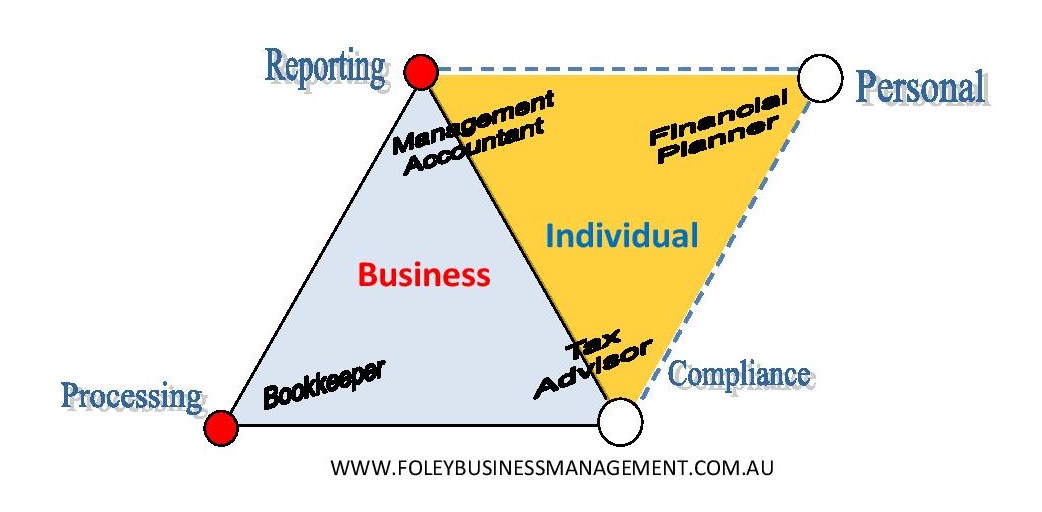
Slanted square with different types of accountantsAccountants are like doctors. If you have a problem with your foot, you speak to a podiatrist. Why? Because you want to speak to the professional with the the most knowledge and experience in that area. Lets run through some of the people who you will speak to around your finances.

4 Different Financial Accountants and Advisors

Bookkeeper

This is the person who does the processing of your accounts to make sure the transactions are entered correctly. In Australia, many Bookkeepers are BAS Agents. You can speak to your Bookkeeper about the day to day aspects of your accounts. For example, your bank account balance, your accounts payable balance and accounts receivables balance. As a BAS Agent they can prepare and discuss your GST liability. Bookkeepers can give general information around your accounts. They are limited in what advice they can provide you.

Management Accountant

Your Management Accountant, can also be your management consultant or company accountant. They are able to give you insight into your business by doing an analysis of your business each month or quarter and providing you with reports and explanations on how you are performing. They are in the position to give you advice on your business to assist you to make more informed business decisions.

Tax Advisor

Your Tax Advisor ensures you are meeting your compliance obligations by providing you with technical advice and services. They can prepare your GST or provide you and your bookkeeper the technical advice on the most appropriate treatment given. They prepare your accounts and tax returns at year end for you and your business, making sure they are compliant for the tax office and other regulatory authorities.

Financial Planner

Your Financial Planner advises you on your current and future personal financial position. Your business is an asset and source of income so it forms a part of this discussion. They manage and advise on affairs such as your superannuation, insurances and investments such as shares.

Relationships

Each has their own area of specialty, but they also work together.

Bookkeeper and Management Accountant

The Management Accountant relies on the Bookkeeper to process and allocate transactions correctly to ensure reports are accurate. Your Management Accountant can work with your Bookkeeper around the reports required and how to setup the accounts to produce the best reports.

Bookkeeper and Tax Advisor

The Bookkeeper will work with the Tax Advisor for technical advice on matters as the correct treatment of transactions for GST and other tax matters. The tax Advisor will require the bookkeeper to prepare the accounts to a standard that allows the Tax Advisor to prepare the financial statements and tax returns. The relationship is sometimes described like a race car driver and the mechanical engineer.

Management Accountant and Tax Advisor

The Management Accountant prepares reports each month and reports this to the client and to the Tax Advisor. This allows the Tax Advisor to plan for the clients tax position before the end of the financial year. The Tax Advisor can then advise what to do prior to the end of the financial year to optimise the clients tax position. For example, the Management Accountant reports may indicate the client will have a larger then anticipated profit at year end, being in three months time. The Tax Advisor can then advise the client on ways to reduce their tax bill in preparation for year end. The Management Accountant can assist the client in implementing this advice.

Management Accountant and Financial Planner

Like the Tax Advisor, the Management Accountant can provide the Financial Planner with business management reports. The Financial Planner can advise the client on what to do with any additional cash in the business from profits or what insurances the client should consider for  the business and themselves.

Financial Planner and Tax Advisor

The Financial Planner and Tax Advisor can both work together on the clients financial position and look at their tax obligations. For example, the business is generating a profit, the Tax Advisor may suggest the client look at some tax effective investments. The Financial Planner may advise on investing more into superannuation through salary sacrifice.

So Which One Do You Use?

If you have a business, all four different advisors are important to you and your business. So when thinking about who you should talk to, you first need to ask who is it for?

If it is for your business, then you will need someone to do your compliance, your Tax Advisor; someone to process your financial information correctly, your Bookkeeper; and someone to analyse and discuss your business financial performance regularly, your Management Accountant.

If it is for you as the individual you will need to talk to someone who can discuss your personal wealth goals, your Financial Planner; someone to prepare your tax returns, your Tax Advisor; and someone to action this within your business, your Management Accountant.

Each of the four contributes to the improvement of you and your business’ financial wealth. Working together, they can provide greater insights into your business and personal finances to allow you to make the necessary improvements.

If you are seeking a bookkeeper or management accountant, consider Foley Business Management. We provide financial management solutions that will allow you to make more informed business decisions around your finances. We want to ensure your business succeeds, providing benefits to you, your family and your community. Our staff have experience working with tax advisors and financial planners. For a 30 minute free initial consultation just email enquiries@foleybizmngt.com


What do I need to ask my accountant before starting a business? 10 questions you need to ask your accountant!

starting a business

Your accountant is a key source of advice on how to start a business. They come with knowledge and experience you can take advantage of if you know the right questions to ask.

If you type in the word ‘businessman’ or ‘businesswoman’ into Google, the images you will see will be all high powered corporate’s in navy blue suit’s. But the reality is many start up businesses are not from a business background. So it is not reasonable to expect you to know everything there is about setting up and running a business.

When I have a leaking pipe, I call a plumber to fix it and I am happy to pay them for it. If the plumber wants business advice, then they come to me and are happy to pay for it.

So to help you on your way to starting your business, here are 10 questions you should ask your accountant before you start.

1. Am I a business?


Some people will start a business that, well, really shouldn’t be a business. There are circumstances where you won’t need to be set up as a business as you simply don’t make enough money or your business really is a hobby.

In certain circumstances it is to your detriment to be a business.  So ask your accountant if you need to be a business. This might save you dollars and hard work you don’t need to do.

2. How should I set up my business?

This is your first question (okay, first question after the first question!) as this establishes how your business will be set up. For example, should you set up as a sole trader, a partnership, a company or a trust? Each will have their pros and cons. Have your accountant ask questions from you about you and your proposed business so they can give you the best advice possible.

3. What are the costs and benefits of this business set up?

Most people consider the initial costs when discussing this point. That is to say how much will it cost to buy a company or draw up a trust deed. But the costs go beyond the initial establishment costs. Consider the ongoing maintenance costs such as accounting fees, annual lodgement fees etc. Also discuss what protection the business structure offers if anything goes wrong. Will the structure protect not only the business assets but more importantly your personal assets such as your house and investment’s?!

4. What type of business do I have? What is Personal Services Income (PSI)?

Leading from question 1, many people take an Australian Business Number (ABN) to make a few extra dollars in addition to their employee pay, especially labourer’s and tradies. But there are rules around how your income is treated and what you can claim for tax deductions. So ask your accountant if you’re business is a PSI business and what that means.

5. Do you have experience in doing work for this type of business?

To give a better understanding about accountants, not all accountants prepare tax returns for a living. Some specialise in certain fields of accounting or in certain industries. For example, doctors can be general practitioners or specialists, accountants can be similar. Asking if your accountant has experience in your business industry is helpful to know but not always necessary.


Ask them what services they can provide you also. For example Foley Business Management provides bookkeeping services including the preparation and lodgement of Business Activity Statements (BAS). We also have additional services, providing management accounting and reporting  and consulting.

6. Will I need to register for GST?

This is an important question as it will

  • impact your selling price
  • your ongoing costs for the preparation and reporting of your Business Activity Statements (BAS) to the Australian Taxation Office
  • paying GST owed.

7. What insurances will I need?

For many businesses you will need some form of insurance. Some of the most common types of insurances a business may have are

  • professional indemnity;
  • product and public liability;
  • income protection or key man insurance,

It is important you have the necessary insurances in place before you start actually trading. Insurance is something you realise you really need after something goes wrong. At this time it is already too late!

8. What expenses should I consider for my business?

A lot of people don’t realise there are a number of business expenses that goes into a business. In addition to the establishment costs there are insurances, accounting, bookkeeping, rent, motor vehicle, mobile phone, plant and equipment, utilities as electricity and water etc. These can be upfront and or an ongoing cost of doing business.

9. What personal expenses can I claim in my business?

Sometimes a draw card to owning a business is being able to claim personal expenses such as a motor vehicle or gym fees and equipment as a ‘business expense’. But the reality is you can’t claim personal expenses. In many cases you will need to justify them as a legitimate business or work expense to claim all or part of the expense as a deduction. BEWARE!! The ATO has identified it will be targeting and scrutinising small businesses in 2017/18.


Some purchases you cannot claim the whole costs irrespective of the business use, such as on a luxury motor vehicle. There is the possible issue that having your business pay for personal expenses will incur Fringe Benefits Tax. Ask your accountant what Fringe Benefits Tax is.

10. Does the business sound like it has potential?

This is where a good accountant with general or specific experience with businesses will be able to give you some feedback. They may not tell you whether the business is going to be a success or failure, but they can give you some critical feedback of their considerations. At the end of the day, you will be the one that makes the decision, not your accountant. But a good accountant will give you their opinion on the matter within means or at least some points to consider before you proceed.

11. BONUS QUESTION- Am I better off just staying as an employee?

Who wants to become the next Mark Zuckerburg or Bill Gates?! Being a business owner sounds great. You become your own boss, you don’t answer to anyone but yourself, you don’t have to worry about superiors telling you how to do your job. Best of all the money you make from your work goes to you. You’re the King of your domain!


The reality is different. 80% of businesses fail in the first year. Nobody sets out to start a business with the intent to fail, but for every 10 that start, 8 will fail. Consider your options.


For some people being an employee and earning a wage is better than pouring all of your savings into a money pit only to go broke.  It is also easier being an employee where your work day starts at 9am and finishes at 5pm, from Monday to Friday. When you’re in business you are working 24/7 as you will never switch off from thinking about it.

Still Feel Like You Need More Help?

Starting a business can be daunting for anyone. As we discussed, a plumber is great at fixing pipes, a management accountant is great at business advice. You aren’t meant to know everything there is before you start and you want to get on with doing what you do best.

Foley Business Management provides financial management solutions to assist small business, not for profit and social enterprise make more informed business decisions around their finances. We provide bookkeeping, management accounting and reporting and consulting services.

If you would like to speak to us as part of our free 30 minute initial consultation then email enquiries@foleybizmngt.com and we will contact you to organise a time to speak over the phone. This is a no obligation service we provide to those wanting to start their journey into business. Otherwise email us your question and we will try to reply with a general response to your situation. This is a once off email provided free, as we have a commitment to our clients to service them.


Pop Up Entrepreneur Event- Social Enterprise

Brisbane Social Enterprises

I had the privilege of listening to and speaking with some inspirational businesses and social enterprises at this event, notably Orange Sky and Good Beer Co. Both have foundations in Brisbane and both are creating a social impact in the world. Orange Sky provide laundry services to the homeless along the east coast of Australia. Good Beer Co donate over 50% of their profits to charities and worthwhile causes.

Small Business Week

The event is part of Advancing Queensland’s Chief Entrepreneur’s pop up entrepreneur events. These are happening all over Queensland in the lead up to Small Business Week from the 15th to 20th May. Mark Sowerby, Queensland’s Chief Entrepreneur and Cat Matson, Brisbane Chief Digital Officer, were both present on the night as MC’s.

Start Up Co Working Spaces in Brisbane

This Pop Up Entrepeneurs event was held in the Brisbane CBD at The Capital, a co working space run by Little Tokyo Two. This is part of a set of co working spaces in the building. The other is Fishburners, who focus on co working spaces for tech startups.

What is Social Enterprise?

Social Enterprise is a very trendy term being used by many businesses. Probably even more so then the term ‘entrepreneur’. But what is a social enterprise? There really isn’t a clear definition that has been agreed to. So let’s look at some.

Social Traders defines social enterprise as ‘businesses that trade to intentionally tackle social problems, improve communities, provide people access to employment and training, or help the environment.’

Queensland Social Enterprise Council (QSEC) defines social enterprise as ‘a business operating for a social purpose.’ This includes ‘Limited distribution of profits and/or distribution of profits with the purpose of maximising social impact – the majority of profits are reinvested in the enterprise and/or an associated social entity and are used to maximise social impact.’

The Not For Profit Law information hub then throws in another question of whether social enterprise is not for profit or for profit when setting up.

What has given rise to Social Enterprise?

Social Enterprise has become an alternate means to

  1. Address social issues from a business angle.
  2. Address the issue of reduced government and corporate funding to the not for profit sector.

Unfortunately in Australia there were some changes to funding not for profit organisations by governments at both federal and state level. This resulted in many who were dependent on government funding having to wind up over night. They had little or no revenue from alternate sources other then government.

Social enterprise is not new to Australia. Many not for profit organisations have sourced revenue through for profit arms. For example, Lifeline and St Vincent de Paul have op shops where people donate goods to be sold through the store. The stores are predominantly staffed by volunteers. The biggest social enterprise in Australia would possibly be Sanitarium, the makers of Weet Bix, who are owned by the Seventh Day Adventist Church.

Millennials are now taking a much greater interest in enterprise and its social impact. They are wanting to know what impact their employer is having in society and the social impact that will be had when they make purchases.

Is Foley Business Management a social enterprise?

Well, our purpose is to build sustainable communities. We assist not for profit, social enterprise and small businesses to make more informed decisions in their financial management. As an Indigenous owned business, we specialise in the Indigenous or Aboriginal and Torres Strait Islander sector. So, we intentionally tackle social problems, improve communities, indirectly and directly provide people access to employment and training. But we are an Indigenous owned business that operates as a for profit where much of our profit is returned into the business.

The Challenge for Social Enterprise

The biggest hurdle for social enterprise is the same for any start up- Cash flow. Many start ventures with good intentions, but do not understand the full implications. Having someone who can manage your finances and be able to provide advice to assist you to make more informed decisions is critical to the success of your social enterprise.

As discussed in the Not For Profit Law Information hub, knowing what type of setup is critical in establishing your social enterprise. Understanding both the for profit and not for profit sides of your social enterprise is a great advantage to any social enterprise.


St Patrick’s Day 2017- Irish Business People in Australia

Foley Business Management has turned our logo from blue to green this week to recognise St Patrick’s Day.

In the lead up to St Patrick’s Day, we recognise the Irish business people of Australia. The Irish have  long connection to Australia since the First Fleet. Ireland has undergone numerous economic and political change that has influenced how business is done both at home and abroad. We have interviewed two Brisbane based Irish business people to share their experiences of Ireland and doing business in Australia.


David GreeneDavid Greene, President of the Queensland Chapter and National Board Member, Irish Australian Chamber of Commerce.


Catherine GabottCatherine Gabott, Owner and Director of Suppawtive Solutions.